
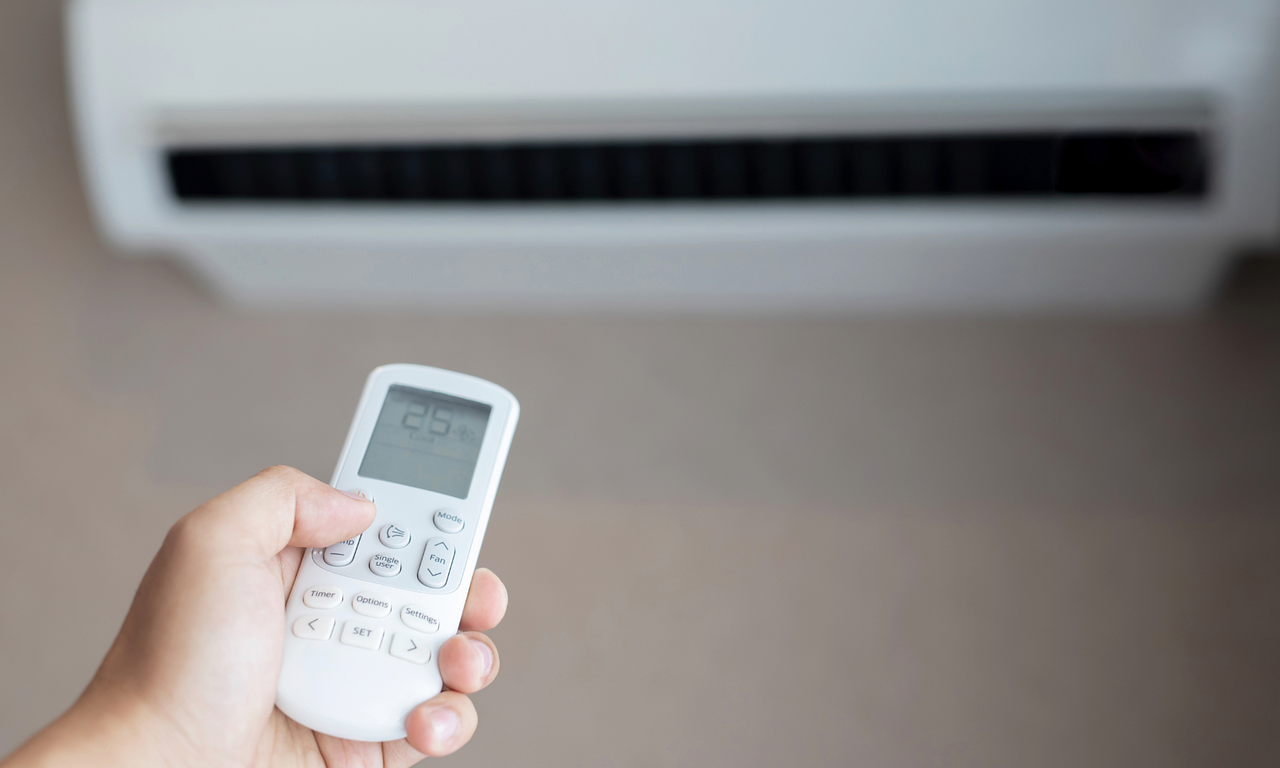
For those who want to use less natural gas but find a heat pump to be too big of an investment, an air conditioner can be a solution. After all, a modern air conditioner can also provide heat. But is that really a good idea?
Air conditioners are popular. More than 300,000 were sold last year. And that’s not just because our summers are getting hotter. Air conditioners are also widely used for heating. In most cases, this can be done fairly efficiently, since an air conditioner is essentially a heat pump. This makes it an energy-efficient way to heat a home, provided the unit has a high energy efficiency rating.
Still, there are quite a few snags to using an air conditioner for heating—something not everyone realizes.
Look beyond the price
One reason air conditioners are so popular is that their purchase price is lower than that of a standard heat pump. Prices for air conditioners range from about €1,600 for a unit that heats or cools a single room (single-split air conditioner) to €3,000 for a unit that heats or cools two rooms (multi-split air conditioner).
Compared to a hybrid heat pump, which starts at around €3,500, an air conditioner might seem like a more economical choice. But is that really the case? What’s often overlooked is that a hybrid heat pump can heat your entire home, since it connects to your central heating system. With an air conditioner, you can heat at most one or two rooms.
In addition, there’s a good chance you’ll use the air conditioner to cool your home in the summer. As long as you use the solar power you’ve generated yourself, this isn’t a problem, of course. But keep in mind: cooling uses more energy than heating. If you use electricity from the grid, the costs can quickly add up.
The experience with an air conditioner is really different
Most people are probably most familiar with air conditioners from vacations: you’ll find them in every hotel room. However, the continuous airflow from such a unit is quickly perceived as a draft. Moreover, it’s difficult to heat or cool the room evenly. Maintaining a consistent temperature is a challenge, and that makes heating with an air conditioner a very different experience from what you’re used to with the gradual warmth of your central heating system.
In addition, radiators are placed under windows to counteract the cold draft. A cold draft is the phenomenon in which air cools rapidly, sinks downward, and creates a circulation that makes a room feel cold. An air conditioner only partially counteracts this. In addition, the heat from underfloor heating or radiators lingers longer than the heat from an air conditioner. As a result, you have to leave the air conditioner on longer to experience the same level of comfort.
Conclusion
An air conditioner is therefore best used as a supplemental heating source. If you also use it for cooling, be mindful of its power consumption. Without your own solar panels, energy costs can quickly add up.
Are you really looking for a solution to heat your entire home? If so, a standard heat pump is almost always the better option. It costs more, but the comfort and heating range you get in return are also significantly better. Plus, it works great for cooling your home by a few degrees when it’s really hot outside.
Would you like to learn more about heat pumps? Then sign up now for our event, “Discover Heat Pumps,” on February 12 in Nieuw-Vennep!