
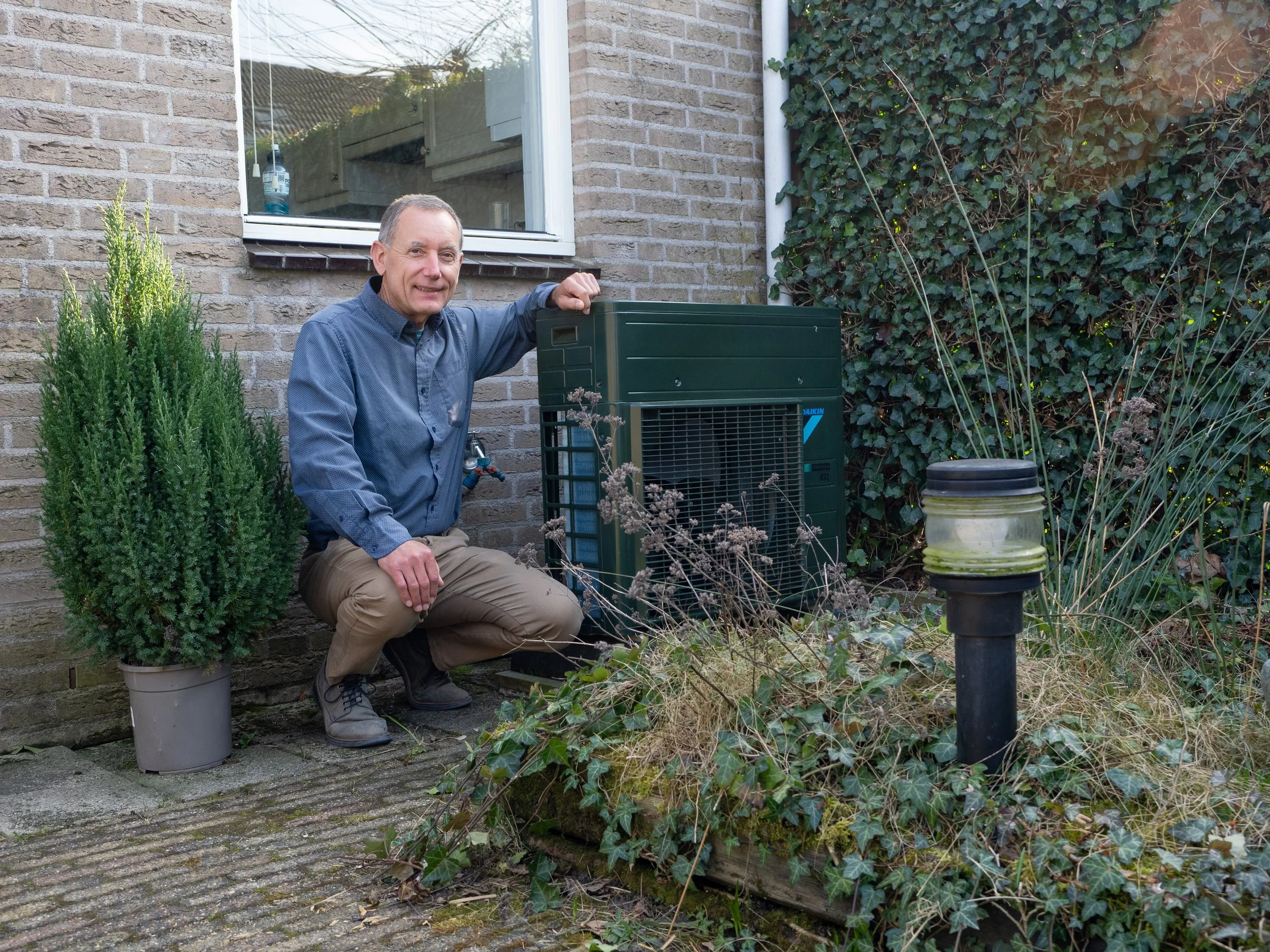
Credits: Jur Engelchor
A year ago, the gas line was removed from Pim Snoeks’ front yard. This marked the definitive end of a gas-heated home and, with it, a new beginning for a sustainable, natural gas-free home. How did it all go?
In the hallway of the corner house in Hoofddorp hangs a framed newspaper clipping from the *Haarlems Dagblad* dating from 1983, announcing the construction of 92 single-family homes. A charming sketch of a neat block of houses with young trees and neighbors chatting completes the picture. No wonder Pim Snoeks and his wife immediately signed up for one of the homes. The young couple got lucky and became the first residents of the corner house. They’ve now been living there happily for forty years.
Favorable construction
However, this wasn’t just any corner house, Pim explains as we take a seat on the green leather sofa. When it was built, the house was well insulated with roof, floor, and wall insulation. Double-pane windows were also installed throughout the house. This was thanks to a forward-thinking developer. Pim explains that this wasn’t the norm: the requirements for home insulation weren’t that high back then. “It all comes down to luck,” he concludes. A stroke of luck that gave them a solid head start when they began making their home more sustainable.
Steps Toward Sustainability
The afternoon sun streams into the bright living room; it’s a good day for the solar panels. Ten years ago, Pim was an early adopter when he installed his solar panels, which were a major investment at the time. A few weeks ago, he replaced the old panels with new ones. It’s a purchase that will quickly pay for itself, Pim believes. They cost much less now and generate more energy. Have you just started making your home more sustainable? Then installing solar panels is “a no-brainer,” Pim argues, because: “you’ll almost always recoup the cost.”
But the Snoeks family didn’t stop at solar panels. A few years ago, Pim read an article about the subsidy for heat pumps and decided not to pass up such a good opportunity. They installed a heat pump water heater, which heats only the water for the shower and kitchen. Pim combined this with a central heating boiler for the heating system.
“That’s when we decided to phase out natural gas.”
After a year of positive experiences with the heat pump water heater, Pim became an energy coach at the Energiebank. That’s when he started feeling the urge to take the next step toward sustainability. “Just to set a good example,” Pim explains. And that’s how the full heat pump came into the picture—and into his home. Two years ago, Pim purchased a full heat pump and had a used induction cooktop installed. Exactly one year ago, the gas line was removed from the front yard: the natural gas-free home was a reality.
The heat pump: the champion of consistent heating
Does he like it? You bet; Pim can rattle off the benefits in a flash. For one thing, a heat pump requires little to no maintenance; it allows you to heat your home sustainably, and it greatly improves your living comfort. That’s because a heat pump provides constant heat, 24 hours a day. As a result, you don’t have to deal with temperature fluctuations in your home, which you might experience when heating with a central heating boiler. “A heat pump is the best at this,” Pim says from experience.
For Pim, switching from natural gas offers more than just greater comfort at home: he saves about €1,000 a year on his energy bill. The conclusion is that this is a significant amount, making it easier to recoup the cost of purchasing the heat pump.
We get up and walk to the backyard, where Pim proudly shows us his outdoor unit, which he’s painted green. It matches perfectly with last year’s Christmas tree, which is standing right next to it. Now that’s what we call a green home.
Tips for Residents
What tips for residents can we take away from this conversation?
Buy a used induction cooktop
Don't like the look of your heat pump's outdoor unit? Paint it a color that suits your style!
Choose a heat pump that suits your needs and energy consumption: a large heat pump isn't always necessary.