
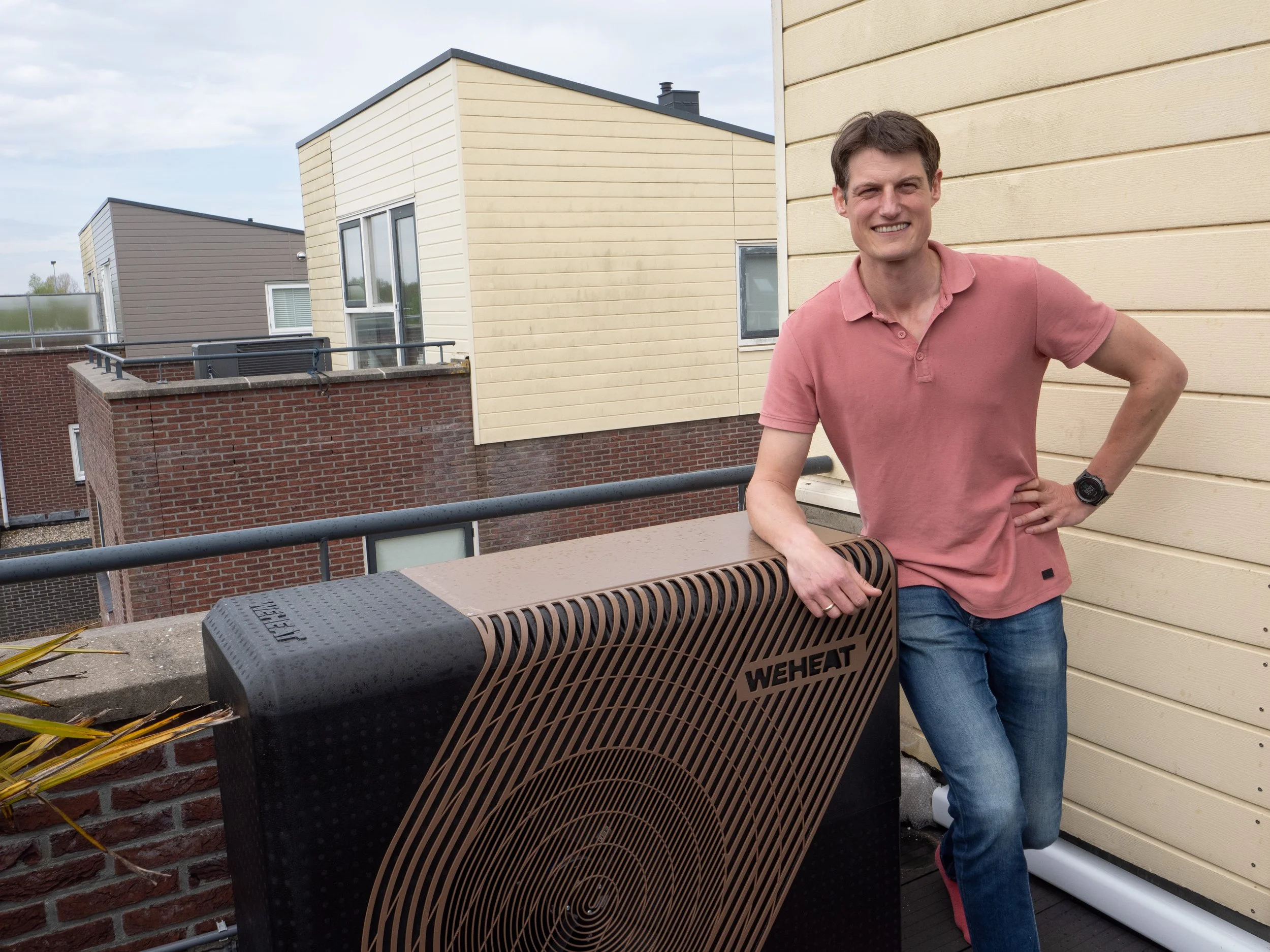
Photo: Jur Engelchor
“Start small, and make it fun.” That’s the advice Hoofddorp resident Andreas van Braam offers to other residents who want to make their homes more sustainable. How did he embark on this green journey? Andreas talks about it in this interview.
The Heat Pump Quagmire
The sun is shining brightly as we take a seat on the picnic bench in Andreas van Braam’s front yard. We’re in the western part of Hoofddorp, in Floriande, where Andreas has lived with his family since 2018. We look out over a serene street scene; aside from ourselves, we hear only the wind rustling through the trees. It’s a beautiful place to build a life. And just as green as these surroundings are, so too is the van Braam family’s semi-detached home. Since the house welcomed its new residents, a great deal of work has been done on the home, which dates back to 2002. A home with surprisingly good insulation. Not a bad starting point for a sustainability project.
This journey began with a Radar broadcast in which the van Braam family’s old boiler was described in less-than-flattering terms: it was on a red list of boilers at risk of exploding. That meant they had to act fast. “Back then, heat pumps weren’t quite as advanced as they are now,” Andreas explains. And so they got a new boiler. A small one with an eco mode, to be sure. He wasn’t entirely satisfied with this outcome: “I didn’t make it through the quagmire.” The proverbial quagmire of buying a heat pump was difficult to navigate: which one do you choose? And how much does it cost? On top of that, the decision had to be made quickly, with a ticking time bomb of a boiler. And after all, choosing a heat pump isn’t something you do on a whim.
But Andreas wasn't one to give up easily. He decided to find out how low he could set the temperature on the boiler to save gas and see if low-temperature heating might also be an option.
Boilers are set to 80 degrees or higher by default; this is what we call high-temperature heating. With low-temperature heating, the temperature of the water flowing through your radiators is lowered, allowing you to heat more efficiently and thus save energy.
It turned out this was possible, so the boiler’s temperature was lowered. As a chemical engineer, Andreas actually enjoys tweaking the controls a bit. And sustainability is important to me, he emphasizes. “I think you should do what you can.”
Do what you can
With this motto in mind, various measures were implemented in the house. Pretty soon, Andreas had solar panels installed: “A logical choice.” The twenty-year-old heat recovery system for ventilation air was also replaced. That’s how the house began to become increasingly eco-friendly.
In addition to his own experiments, he was also inspired by his neighborhood, where more and more people were working to make their homes more sustainable. “You don’t want to be left behind,” Andreas says with a laugh. His thinking was: if the neighbors can switch off gas, so can I. It didn’t turn into a sustainability race, but the idea of a heat pump did continue to appeal to him. Andreas requested quotes, learned more and more about it, and then took the plunge. The installation of the heat pump went smoothly: “Everything was done very neatly.”
And just like that, the green cycle was complete. How has this improved things for him? The new heat recovery system is much quieter than the old one, which makes the house a more peaceful place. And with the heat pump, energy consumption is much more efficient. Switching off gas also means you no longer have to pay for the gas connection, which saves nearly 300 euros a year. And, not unimportantly, a natural gas-free home is much safer. “We don’t have any matches in the house anymore,” Andreas concludes with satisfaction.
We ask him what advice he would give to others. “Start with the simplest things,” he says right away. “That really does save you a lot of money.” Install draft stoppers, he recommends, and familiarize yourself with your boiler’s settings. But also: install radiator fans. These boosters, shown in the photo below, ensure that heat is distributed more quickly and evenly throughout the room, warming it up and helping you save energy. Andreas also emphasizes the importance of paying attention to energy consumption. Is it really necessary to heat every room? By being mindful of this, you can save money and do your part for the environment.
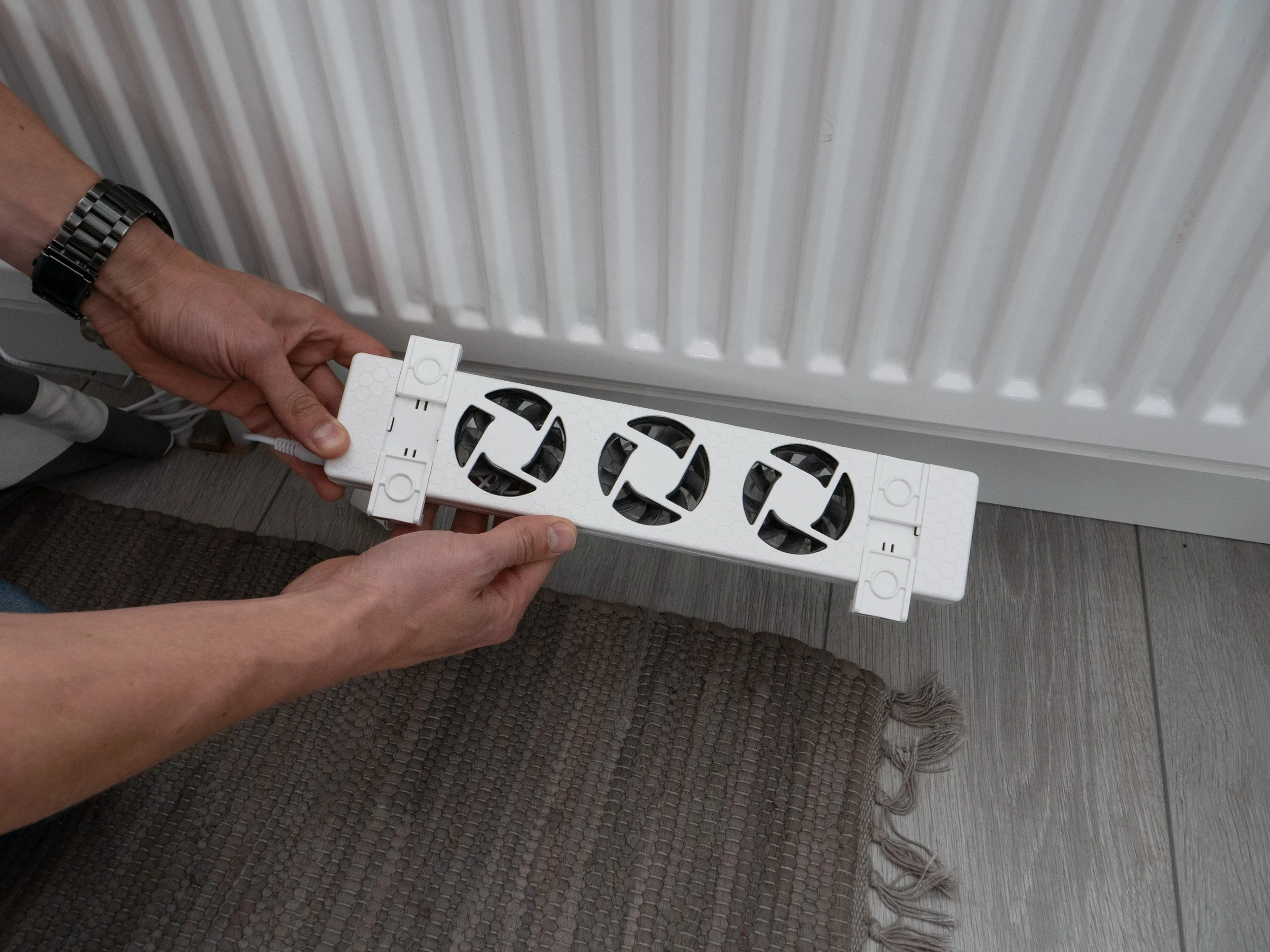
“Start with the simplest things. That really does bring in a lot of money.”
Green Dreams
Andreas also likes to do his part in other ways in his daily life: being mindful about his possessions, not just buying everything new, replacing a few tiles each year, and designing his garden with a circular approach. But he certainly still has some green dreams. More green roofs, Andreas says. To keep the house nice and cool in the summer. He’s also thinking about a home battery: “If net metering ends and prices drop even further, that will definitely be interesting—especially if you drive an electric car.”
For now, this is still a long way off. But this natural gas-free home is certainly future-proof. And all of that was achieved by starting small and making it a little fun. With this positive thought in mind, we bid farewell to the green Floriande.