
Photo: Jur Engelchor
Dick Leenheer warmly welcomes us into his sustainable home in Floriande. We walk into the spacious living room, where light streams in—even on a drizzly fall day like this one. The windows overlook a small ditch—a body of water that was a deciding factor for him when he bought the house, Dick explains.
Floriande is a neighborhood where many residents are working to make their homes more sustainable; we previously interviewed Andreas, a neighbor further down the street. Just a glance over the fence can be enough to inspire you to get started yourself. But for Dick, it wasn’t a glance over the fence that prompted him to implement energy-saving measures.
A forward-looking perspective
After purchasing the house in 2017, a major renovation lasting several months followed. During this process, the Leenheer family made “choices that ultimately helped make the house more sustainable,” as Dick explains. Underfloor heating was installed, the radiators were removed, and the meter box was modified. This was just the beginning of a series of energy-saving upgrades to the home.
The project got off to a good start: the relatively new home, built in 2002, was well insulated on the outside. However, the floor could still use an extra layer of insulation, which was added in the form of Tonzon insulation. This also immediately addressed the high humidity in the crawl space. This investment proved to be a wise one: it led to a doubling of the insulation value. “If you were to have a house built today, you’d have roughly the same insulation value,” Dick explains. That does wonders for the energy rating. But it also made a big difference in terms of comfort: “You notice that the floor stays warm more evenly,” Dick concludes with satisfaction.
The Heat Pump Wish
When the solar panels were installed on the roof in 2021, the family had already been living happily in Floriande for quite some time. But Dick wanted more. The idea of a heat pump was tempting, but there were a few other steps that needed to be taken first.
First, Dick set to work on his own to see if it was a good time to install a heat pump. He set the boiler to 60 degrees to save energy and eventually even lowered it to 50 degrees to see if the house was ready for a heat pump. There are lots of helpful videos that can assist you with this, Dick explains. That’s how he came up with the following tip: “Anywhere on the street where you see white smoke coming out of the chimney, the boiler isn’t set optimally and a lot of heat is being lost,” he explains. A simple but effective tip; “I even took a look at my own roof,” Dick admits with a laugh.
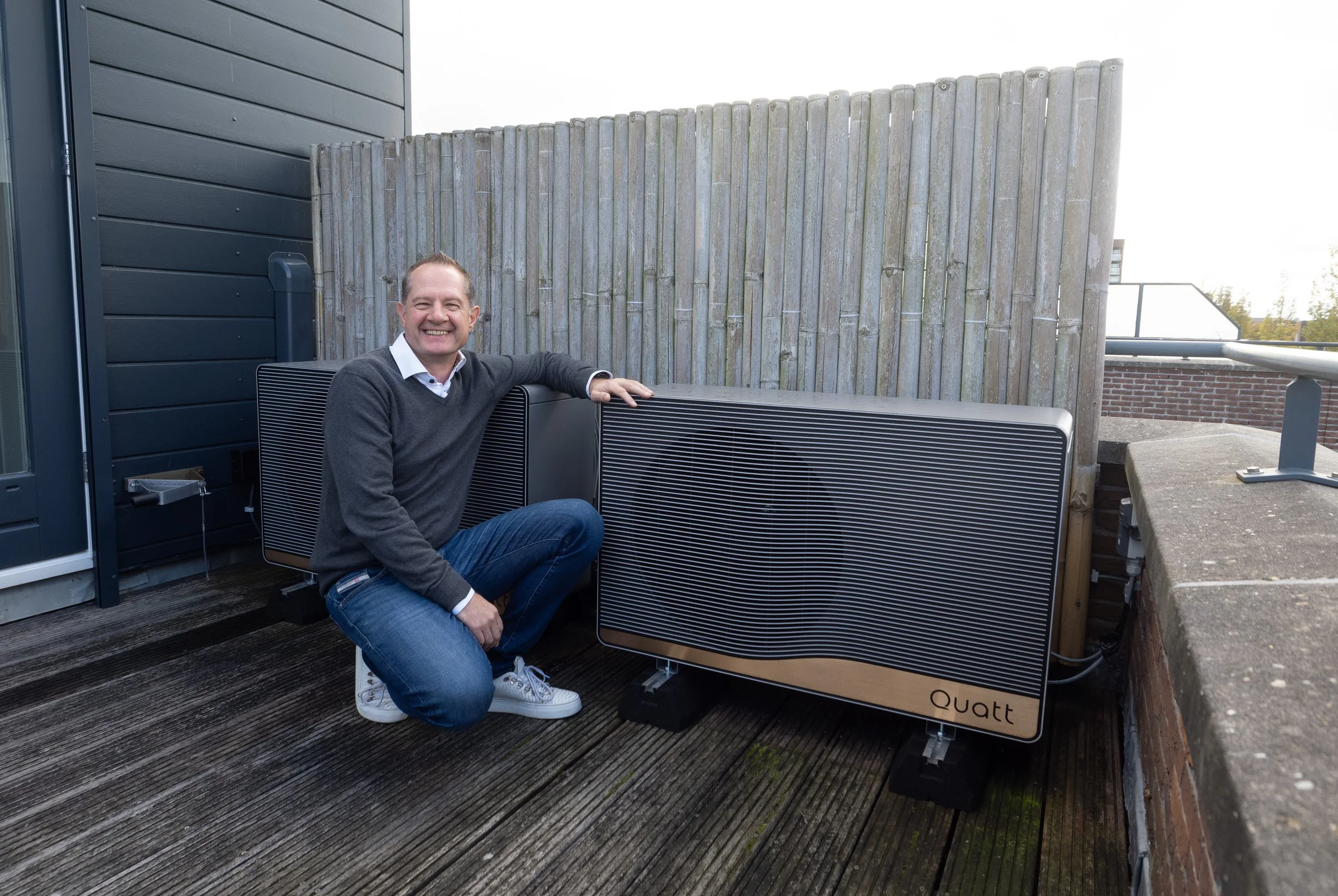
Lowering the boiler temperature confirmed to Dick that the house was indeed ready for it. Once he had managed to run electrical wires upstairs, where the heat pump would be installed, it was welcomed with open arms. Dick purchased two Dutch Hybrid Duo heat pumps so that the units could take turns operating and wouldn’t have to run constantly. This extends the lifespan of both heat pumps.
The decision had been made, and since this summer, two beautiful heat pump units have been installed on the balcony. They’re working out well, especially during these first cold days of fall.
Sustainable Homes Tour
And so Dick has come a long way. Like many others, he started out for financial reasons, with the energy crisis in mind. But for the past few months, Dick has also been working as a volunteer energy coach at the Energieloket. He visits people in their homes to help them take steps toward a more sustainable home. Awareness is important in the energy transition, Dick emphasizes. But he also wants to show people what concrete steps they can take. That’s why Dick is participating in the Sustainable Homes Tour on November 1. The Mobile Energy Help Desk will be parked outside his house that day, and together with our energy advisor, Dick will talk about his journey toward a more sustainable home. Would you like to learn more about Dick’s experiences? You can read more about the Sustainable Homes Route on this page.
Tips from Dick:
“Start by raising awareness: What can I do myself to make sure I use less?”
Insulation is a good first step: make your home draft-free and seal any cracks and gaps. Want to learn more? Then go to this page on small steps.
Take a look at your chimney: is there white smoke coming out? That doesn't mean a new pope has been elected, but it does mean you can turn down the heat on your boiler. How? You can read all about it at zetmop60.nl. Or check out a video on the YouTube channel Ketelklets.
“People are used to the comfort they have—whether it’s good or bad.” So ask yourself: “Is this comfort really efficient, or could it be improved?”