
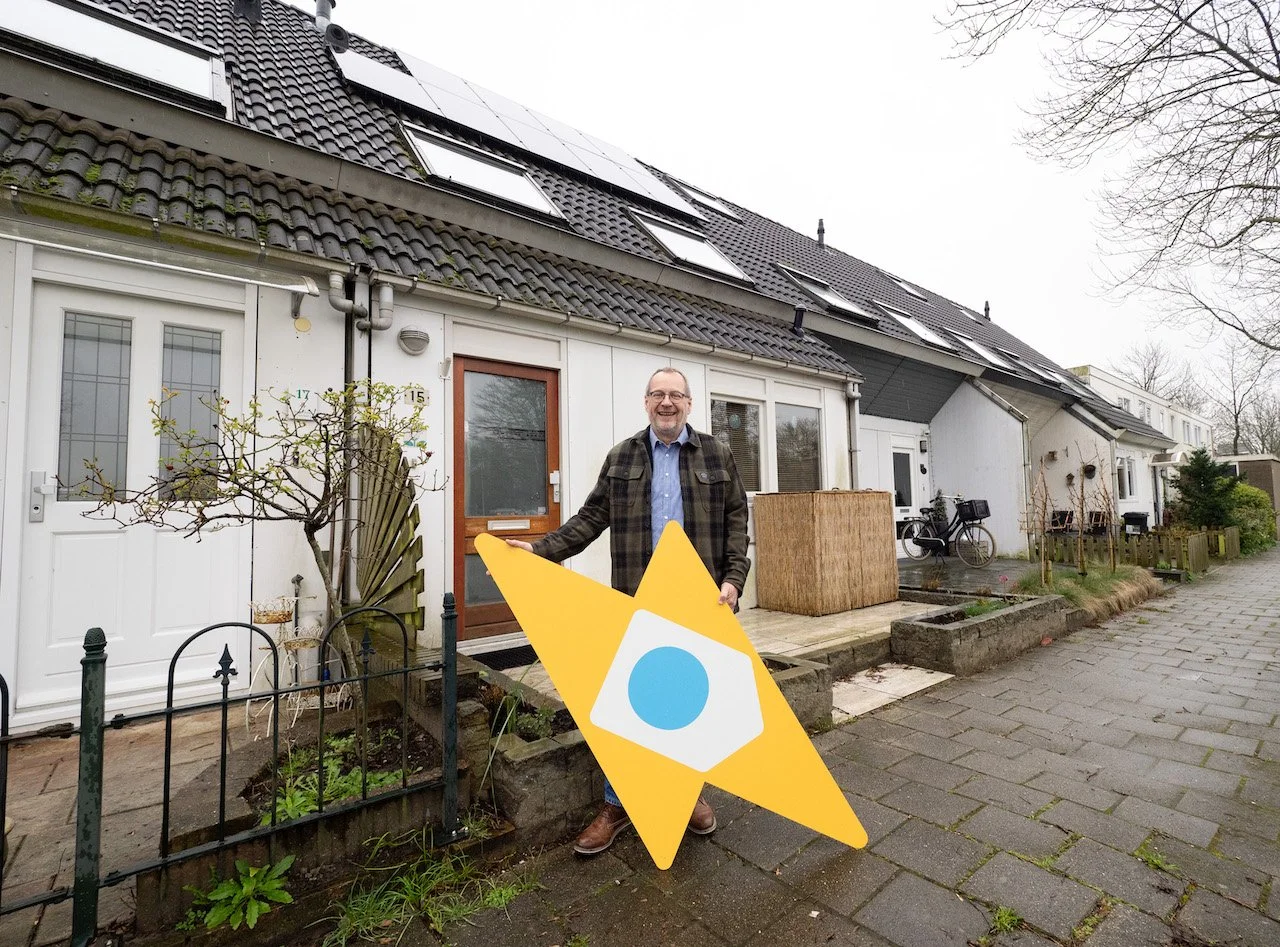
This time, we’re sharing Arjen Wols’s experiences. He lives with his wife and teenage son in a 1980s-era home in the Overbos neighborhood of Hoofddorp and has been off gas since 2017.
Arjen: “I became interested in our home’s energy consumption early on—long before most people were even thinking about it. I started by measuring our total gas and electricity usage. I did this by placing temperature sensors on the pipes. I compared my usage to averages for similar homes, which let me know exactly where I stood. You could say I’m a bit of a control freak.”
Lowering the Boiler Temperature
In April 2014, Arjen decided to investigate whether he could lowerthe temperatureof his boilerwhile maintaining the comfort level in his home. Arjen: “I just thought it was a waste to use energy unnecessarily. Nowadays, it’s the most normal thing in the world to do that, but back then, people looked at me strangely.”
He managed to lower the temperature of the boiler, maintain comfort, and save energy. Because the house was built in the mid-1980s, it was already sufficiently insulated for Arjen. Despite the gas savings, Arjen wanted more, so he looked for a complete alternative to gas heating.
Looking for the Right Solution
Arjen: “It was quite a quest to find the right solutionfor our situation. I didn’t want a heat pump’s outdoor unit on my roof. Back then, they weren’t as quiet as they are now. So I started lookingfor a system without an outdoor unit and ended up with a heat pump with PVT panels. It’s a system that few people have purchased. At the time, we were among the supplier’s first pilot customers. Most suppliers didn’t dare to offer it either. They advised me to keep the boiler running for a while longer. That was in 2017.”
PVT panels
Arjen’s heat pump does not have an outdoor unit, but operates using eight so-called PVT panels (heat exchanger panels). This is a system with a solar panel on top and a network of pipes on the bottom that extracts heat from the outside air. A heat exchanger transfers the heat to the heat pump. In addition to the PVT panels, 17 standard solar panels supply the heat pump with electricity.

Arjen: “The heat pump is connected to a 300-liter buffer tank, which is maintained at a temperature of 50 degrees Celsius. This buffer tank supplies hot water for the radiant floor heating. In addition, a tap water line runs through the buffer tank, connected to an instantaneous water heater that further heats the tap water to a temperature of 55 degrees when there is a demand for hot water. We had a separate control system installed that ensures the tap water is already at a comfortable temperature.”
Efficient Use
Arjen now knows how to use his heat pump as efficiently as possible. Arjen: “I’ve set the thermostat so that the radiant floor heating turns on between 12:00 and 13:00. This allows the buffer tank to be heated by direct sunlight. When we start cooking in the evening and turn on the heat, the storage tank is already warm again, so the pump uses less energy to provide us with heat.”
Net Metering ProgramSometimes the PV panels aren’t able to heat the water heater tank to the desired temperature. In that case, electric heating is used to supplement it. Arjen: “Either way, the house remains net-zero, but unfortunately, the bill isn’t zero. Net metering can’t bring your bill down to zero because the cost of your electricity is shifted from the generation source to the transmission system. You now pay for the underground power lines regardless of your consumption or the electricity you feed back into the grid.”
For that reason, Arjen would like to switch to a home battery in the future. Arjen: “I expect the cost of electricity to go down. But the cost of the infrastructure will only go up. Right now, there aren’t any affordable batteries that would let me save on my utility bills. So I’m going to wait a little while longer.”
Financial Benefits
Arjen now pays only 15 euros per month in energy costs, based on an average electricity consumption of 3,500 kWh. Arjen: “We invested 21,000 euros in the heat pump system, the solar panels, and the underfloor heating. We also had to install an additional circuit. We’ll recoup the investment by 2027. Plus, we’ve gone from Energy Label C to A+++.”