

Daniël Dieben (35) lives with his wife in a 1990s-era home on Marga Klompésingel in Hoofddorp. After their all-electric heat pump was installed, the couple immediately had the gas line removed. That was six months ago. We asked Daniël about his experience.
What sustainability measures have you implemented in your home?
When we moved into our house in 2019, the bathroom was remodeled. With a future heat pump in mind, we had underfloor heating installed right away. In addition, a shower heat recovery system was installed. This system uses the heat from the outgoing water to preheat the cold water. As a result, our gas consumption for hot water has dropped by 50%!
We also had the exterior walls re-insulated. HR++ glass was installed in the rear windows, and because of its soundproofing properties, we had triple-pane glass installed on the front.
We have 27 solar panels on our roof, most of which I installed myself. I learned how to do this through the Tweakers platform. Since I’m pretty handy, I decided to tackle the job on my own. I also installed most of our heat pump system myself. I outsourced the tasks that require an STEK certificate*. We were still able to take advantage of the ISDE subsidy, but starting in August 2023, this will no longer apply to self-installed systems. The entire installation must be carried out by a company.
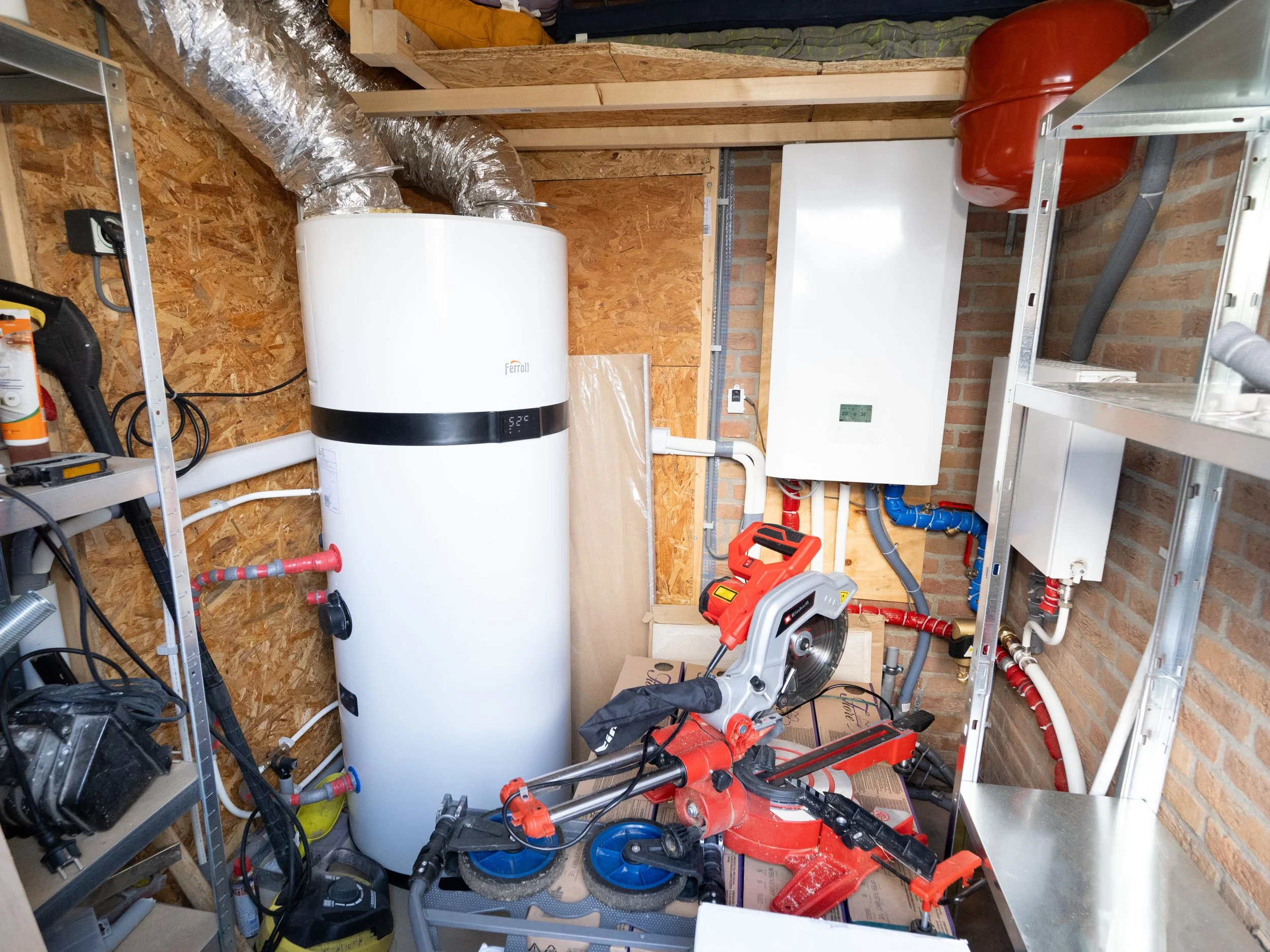
The heat pump is located in our shed, with the outdoor unit on the outside. To prevent noise pollution, I had a special enclosure built around it. After the pump was installed, I immediately had the gas connection removed. That was in May 2023. Until then, we had been heating our home with air conditioners, which we had installed in our living room and study in 2019.
Have you also taken ventilation into account?
That’s actually something for the future. Right now, we only have small vents above the windows that let fresh air into the house. Eventually, I want to install a ventilation system with heat recovery. Such a system removes stale air and brings in fresh air, directing the stale, heated air past the incoming cold, fresh air so that the heat is reused.
What motivated you to become more sustainable?
First and foremost, to save money. It all started when I had an air conditioner installed in my office. When I found out that it could also be used for heating—and that the unit works just like a heat pump—it got me thinking. In 2019, our energy bill was 1,200 euros! Now it costs us nothing. In 2022, we even had 1,800 kWh of electricity to spare.
What are the benefits of your sustainability efforts for you?
In addition to the financial aspect, there's also the comfort factor. It's comfortable in the house 24 hours a day, and it's never cold.
Are there any sustainability initiatives still in the planning stages?
Yes, we’re also getting underfloor heating in the living room at the end of March. Right now, there are still old-fashioned radiators, under which I’ve installed small convectors. This works great in combination with the heat pump, by the way. We’re installing the underfloor heating for even more comfort.
Would you recommend that others make their lives more sustainable?
Absolutely. Especially if you consider the financial benefits. Of course, you have to make an investment, but you also have to think long-term. Just for using the gas line, you pay 300 euros a year, so in 10 years you’ll have spent 3,000 euros for nothing. On top of that, you also have to pay for an annual maintenance check on the furnace. A heat pump system is much easier to maintain.
Have you encouraged others to adopt more sustainable practices as well?
Absolutely. But it took a while. When I first installed my air conditioner so I could use it for heating too, the people around me didn’t believe it would work. They ended up changing their minds. Now my dad has an air conditioner unit downstairs and upstairs.
My advice to people: just be critical when requesting quotes. Prices vary wildly. Also, my opinion on insulation might be a little controversial. I think it’s better to invest in a heat pump than to spend money on (further) insulating your home. Especially when it comes to expensive insulation measures. The higher your gas consumption, the sooner you’ll recoup the investment in a heat pump. That said, I should mention that adding insulation does make your home more comfortable and helps it heat up faster when the heat pump is operating at a low temperature.
Another thing to keep in mind in the heat pump industry is backup heaters. Heat pumps contain an electric heating element that turns on when the heat pump can’t handle the load. What often happens is that people are advised to choose a heat pump that’s too small, which quickly switches to the backup heater when it gets cold. Think of it like the heating element in a kettle. For every kWh you put in, you get 1 kWh back. The power of the heat pump lies precisely in its ability to turn one kWh into two, three, or four kWh. If this doesn’t happen, your energy bill will skyrocket.
*STEK is an acronym that stands for Stichting Emissiepreventie Koudetechniek (Foundation for Emission Prevention in Refrigeration Technology). The STEK certificate is required for every technician who works on refrigeration and air-conditioning systems that may release fluorinated greenhouse gases or controlled substances.