
For most Dutch people, cooking with natural gas is still the most normal thing in the world. But induction cooking is the future. Energy consultant Rogier explains why.
How Induction Works
An induction cooktop contains electrical coils that generate a magnetic field. This is converted into heat inside the pan. You often don’t need to buy new pans for this. Check the bottom of a pan to see if it’s suitable, or test it with a magnet. If the magnet sticks to the pan, it’s suitable for induction.
The Benefits
With induction, the pan only gets hot when it's on the cooktop. If you remove the pan, the cooktop stops heating. So it's much safer than gas. Plus, an induction cooktop is completely flat, making it easy to clean.
An induction cooktop extension allows you to expand your countertop and workspace. Cooking with induction is very fast, responds instantly, and distributes heat evenly across the bottom of the pan.

Induction cooktop with an induction protector on top.
An induction cooktop uses about 175 kWh per year. Cooking with gas uses about 37 m³ of gas per year. In terms of cost, the difference isn’t huge. But because gas is becoming more expensive on average—mainly due to ever-rising energy taxes—and electricity is becoming cheaper on average (especially if you have solar panels), that difference will grow. The advantage, then, lies with induction cooking.
The CO2 emissions from 37 m³ of gas are about 80 kg per year. If you cook with an induction stove, you can use green electricity, in which case the CO2 emissions are 0 kg per year.
And then there’s the biggest advantage: when cooking with induction, you don’t inhale any toxic gases. Burning gas releases harmful substances into your kitchen, such as benzene, nitrogen dioxide, and methane. While cooking, your face is right above the stove, making it easy to inhale these substances. In addition, cooking with gas increases the amount of CO2 and moisture in your home. Fortunately, having a good range hood with an exhaust vent to the outside does help. It’s also a good idea to open a window when cooking with gas.
The costs
Be prepared for additional costs if you want to switch to induction. In many cases, a separate electrical line must be run to the kitchen, and the circuit breaker panel must be expanded to include 1 to 3 additional circuits. The old cooktop must also be removed, and the gas line in the kitchen must be capped off. All of this together costs about €500 to €800.
In addition, your connection to the power grid may need to be upgraded. Older homes sometimes have a 1 x 25 A connection. Upgrading your connection to 3 x 25 A costs over €200. Upgrading from 1 x 25 A to 1 x 35 A or 1 x 40 A is free in some cases (see the grid operator’s website for more information). Newly built homes often already have this, so you won’t need to upgrade anything. You also won’t need to upgrade a 1 x 35 A or 1 x 40 A connection if you choose an induction cooktop with a power rating of up to 7,360 watts. Be sure to keep this in mind when making your purchase. In that case, do take into account the simultaneous use of multiple high-power appliances such as the dishwasher, oven, washing machine, dryer, water heater, etc.
An induction cooktop costs between €200 and €2,400. When you factor in the cost of new pots and pans (if needed), the extra power cord, the additional circuit(s) in the electrical panel, and possibly upgrading your electrical connection, the total cost can range from €1,500 to €3,000. Of course, this depends on your specific situation and the type of induction cooktop you purchase.
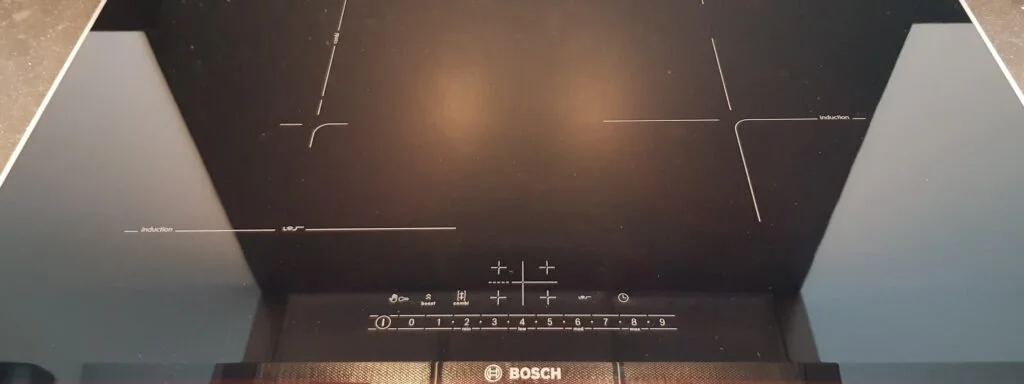
Induction cooktop with 4 burners/cooking zones.
Isn't there another way?
There are also induction cooktops with a standard plug that can be connected to a single-phase outlet. In that case, you won’t have any of these extra costs. But keep in mind that you can’t simply use all the burners at maximum power at the same time. In many cases, the induction cooktop will distribute the power among the burners or disable certain functions.
If you choose this solution, be sure to check whether the cooktop is compatible with a single-phase connection. For example, with a 1 x 16 A connection, the cooktop must not exceed 3,680 watts. Ask about this at an electronics store or read the specifications carefully if you’re buying online.
Natural Gas-Free
An induction cooktop is part of a natural gas-free home. Most people who install a heat pump also replace their gas stove with an induction cooktop and then have the gas line removed. Of course, you can have an induction cooktop installed at an earlier stage. And if you have the electrical connection upgraded at that time, it will also be ready for the heat pump.
Fortunately, cooking with induction doesn't have to be expensive. In any case, it's definitely healthier and more sustainable! That's why induction cooking is the future.

By: Rogier Charles