
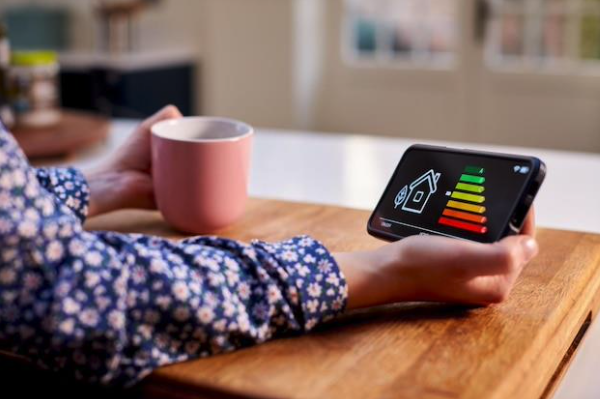
For years, it was common knowledge: solar panels are a good investment. But the phase-out of the net metering program starting in 2027 is making people hesitate about purchasing solar panels. However, even without net metering, solar panels are and will remain a good investment—especially if you use as much of the electricity you generate as possible right away. In this article, we’ll explain how to do that.
Net Metering
But what does “net metering” actually mean? If your solar panels generate more electricity than you need at that moment, that excess electricity is fed back into the power grid. Later, when you do need electricity (for example, in the evening when the sun has set), you draw power from the grid again. The amount of electricity you feed back into the grid and the amount you use later are compared and offset against each other. This is called net metering.
Inverter
It’s important to get to know your own consumption patterns well. Once you know how much solar power you generate and how much electricity you use at home, you can manage your generated power wisely. But how can you determine your consumption?
The inverter for your solar panels often has an app that lets you see how much solar power you’re generating. This way, you can see when your solar panels produce the most power—for example, between 11:00 a.m. and 3:00 p.m., when the sun is highest in the sky.
P1 Meter
Want to know when electricity usage peaks in your home and which appliances use the most power? Then the P1 Meter might be right for you. A P1 meter is a small device that you plug directly into your smart meter. By installing a P1 meter, you can see—either through the P1 meter app or on a display—at what time of day you’re using your own solar power.
Peak Production
Peak solar power production depends on the weather: more sun logically means a higher yield. The orientation of the solar panels on your roof also plays a key role. These are the times when you use a lot of electricity. Are your panels facing east? Then you’ll generate the most solar power in the morning.
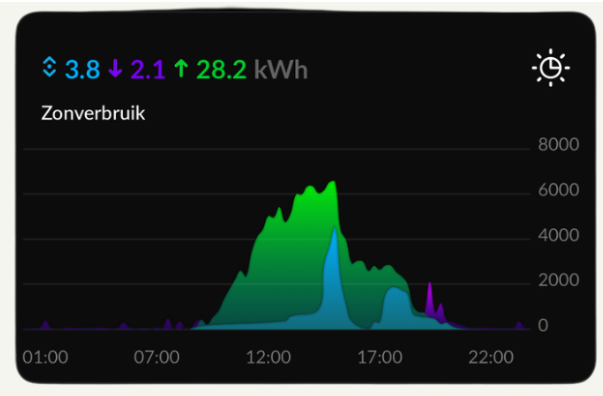
Example: 28.8 kWh of solar power generation (green graph), of which 3.8 kWh was consumed (blue graph).
Tips
Once you understand when your system generates power and when you use it, you can make the most of your own solar power. Keep the following tips in mind:
Turn on your dishwasher, washing machine, or dryer during peak output times for your solar panels. These appliances use a lot of electricity. Some appliances have a timer function, which lets you delay a cycle and have it start during a peak output time.
Do you have an electric car parked outside? Charge your electric car during the day, when the sun is shining.
Do you still have a gas stove? Switch to an induction cooktop and, if possible, turn it on during peak hours.
Do you have any gas-powered (gardening) tools, such as a lawn mower or hedge trimmer? Replace them with an electric model where you can charge the battery during peak power generation.
Do you have a (smart) water heater? Raise the temperature during peak hours or consider a water heater with smart controls, such as a hot water storage tank. A water storage tank heats the water in an electric water heater at times when your solar panels are feeding power back into the grid.
With smart plugs, you can turn devices on or off using an app on your cell phone. This lets you turn on electrical devices remotely whenever you choose.
In conclusion: if you follow the tips in this article, you’ll be working toward saving energy and using more green electricity. By raising awareness and adopting new habits, you’ll continue to get the most out of the solar power you generate—even after 2027!