
Improve Your Label
Improving your energy efficiency rating will make your home warmer and more comfortable. Plus, you’ll spend less on energy bills, while your home’s value increases. In some cases, your mortgage payments might even go down! So what are you waiting for?
Your home is worth it.
On average, Dutch homes have an energy efficiency rating of C. That’s actually pretty good. But there are still plenty of homes with ratings of D, E, F, or G. There’s still a lot of room for improvement! Because a better energy efficiency rating means:
More comfort at home
Lower energy costs
Higher home value
Why should I improve my energy efficiency rating?
First of all, a high energy efficiency rating means better insulation and lower energy consumption. As a resident, you’ll benefit from this right away. But a high energy efficiency rating (A or B) can also mean a lower mortgage interest rate. Ask your mortgage lender about this.
Are you planning to sell your home (in the future)? The fact is that homes with a high energy rating sell faster and are worth more.
To help you get started, we're also organizing a meeting:
Event: Discover the Heat Pump
May 6 at 7:00 p.m. | Maatvast De Boerderij
Address: Lutulistraat 139, Hoofddorp
Click here to register for the event and get more information
Ready to get started?
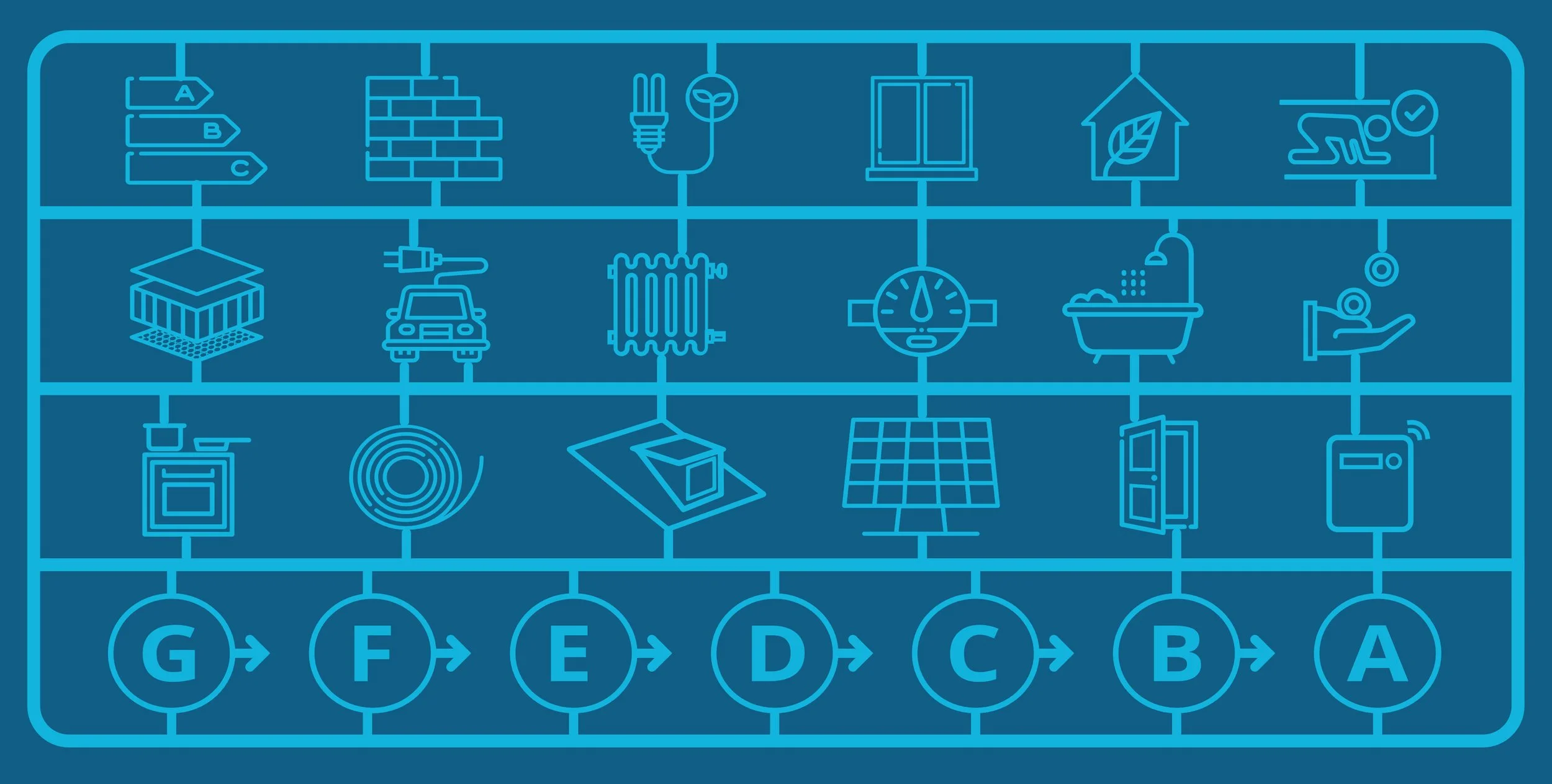
Since every home is different, it’s a good idea to seek personalized advice. But in general, you can follow the step-by-step guide below:
Step 1: Improve Insulation

-
Most heat is lost through the roof and ventilation ducts. Insulating your roof is therefore a smart move if you want to improve your energy rating. This is often a project you can easily do yourself. Do you only use your attic for storage? If so, it may be easier and more cost-effective to insulate the attic floor.
Sealing (visible) cracks is also extremely important—both for comfort and for improving your energy rating. Take a close look at areas where heat can easily “escape,” such as window frames and door frames.
-
In addition to insulating your roof, your windows, floor, and walls are also important. Cavity wall insulation is very effective and relatively affordable. Just make sure the installer takes into account the possible presence of bats in the cavity. You can find more information about cavity wall insulation here.
There are several ways to insulate your floor. Do you have a crawl space? Then check here. Don't have a crawl space? Then you'll find the options here.
Replacing old (double-pane) glass with HR++ glass is also an effective measure. This is especially true in rooms where you spend a lot of time, such as the living room, kitchen, or home office. Check out our overview page on glass insulation.
-
Yes. In addition to the national (ISDE) subsidy, the municipality of Haarlemmermeer also offers a local subsidy for floor and window insulation. This is called the insulation subsidy.
This subsidy amounts to up to €1,325. However, your home must have a maximum WOZ value of €445,000 (as of January 1, 2022) and an energy label of D, E, F, or G. You can apply for this subsidy in addition to the ISDE subsidy, which makes it even more attractive.
Want to learn more? Check out our page on the insulation subsidy.
Step 2: Reduce consumption
-
If your insulation is up to standard, you’ll use less gas for heating anyway. But you can do even more by choosing an energy-efficient kitchen water heater or furnace. This can make a big difference, especially compared to older systems.
Do you want to make a real difference? Then you can opt for a heat pump. With a hybrid model, you heat your home electrically but keep the gas boiler for heating tap water. This will help you save about 60 to 70% on your gas usage.
With a fully electric heat pump, you also heat your tap water electrically and no longer use any gas at all.
-
Significantly reducing your natural gas consumption is (usually) accompanied by an increase in your electricity consumption. But it matters how that electricity is generated. Do you have solar panels? If so, this contributes to a higher energy rating.
-
A national (ISDE) subsidy is available for the purchase of a heat pump. The amount of the subsidy depends on the capacity, the energy label, and the type of heat pump. There is no local subsidy from the municipality for heat pumps.
The ISDE subsidy for an air-to-water heat pump (the most commonly sold type) consists of an initial payment of €1,025 and a payment of €225 per kW of capacity. Does the heat pump have an A+++ energy rating? If so, you’ll receive an additional bonus of €200.
-
Absolutely. On May 6, we're hosting an event in Hoofddorp about heat pumps and low-temperature heating. Check out our events page to register.
Step 3: Additional Measures

-
Ventilation is necessary, but you can prevent unnecessary heat loss by choosing a heat recovery ventilation system. This system uses the heat from the exhaust air to warm the supply air. A CO2-controlled ventilation system ensures that ventilation occurs only when necessary.
Did you know that, starting in January 2026, you’ll be eligible for a subsidy for energy-efficient ventilation systems? You can find more information on the RVO website.
-
When determining an energy rating, the sustainability of the energy used is also taken into account. Having solar panels is therefore a major plus. Just make sure that the number of solar panels is in line with your (future) energy consumption.
-
About 5% of your total gas consumption goes toward cooking. That’s relatively little, but it’s still worth switching to electric cooking—especially induction. Induction is, in fact, the most energy-efficient form of electric cooking. This factor is also taken into account when determining your energy label.
Would you like personalized advice? Stop by the Mobile Energy Help Desk!
During the "Improve Your Label" campaign, we'll be on hand with the Mobile Energy Help Desk and our Energy Bike at various locations throughout the municipality. We’re happy to provide you with advice on implementing small energy-saving measures in your home.
Here's where you can find us in March and April:
Tuesday, March 3, 10:00 a.m. – 1:00 p.m.
Overbos weekly market
‘t Paradijs shopping center, Hoofddorp
Saturday, March 7, 12:00 p.m. – 3:00 p.m.
Gamma Cruquius (in the parking lot)
Spaarneweg 44, Cruquius
Wednesday, March 11, 10:00 a.m. – 1:00 p.m.
Toolenburg Weekly Market
Hoofddorp
Friday, March 13, 10:00 a.m. – 1:00 p.m. *
Symfonie Shopping Center (inside, near the escalators)
Nieuw-Vennep
Tuesday, March 17, 10:00 a.m. – 1:00 p.m. *
Vier Meren Shopping Center (inside, near the escalators)
Hoofddorp
Thursday, March 19, 9:30 a.m. – 11:45 a.m.
Harmonieplein Weekly Market
Nieuw-Vennep
Friday, March 27, 10:00 a.m. – 1:00 p.m.
Gamma Hoofddorp (in the parking lot)
Noordmeerstraat 22, Hoofddorp
Thursday, April 2, 10:00 a.m. – 1:00 p.m. *
Symfonie Shopping Center (inside, near the escalators)
Nieuw-Vennep
Tuesday, April 7, 10:00 a.m. – 1:00 p.m.
Overbos weekly market
Hoofddorp
Thursday, April 9, 10:00 a.m. – 1:00 p.m. *
Vier Meren Shopping Center (inside, near the escalators)
Hoofddorp
Thursday, April 16, 10:00 a.m. – 1:00 p.m.
Harmonieplein Weekly Market
Nieuw-Vennep
Saturday, April 18, 12:00 p.m. – 3:00 p.m.
Gamma Cruquius (in the parking lot)
Spaarneweg 44, Cruquius
(*) = Energy Bike