
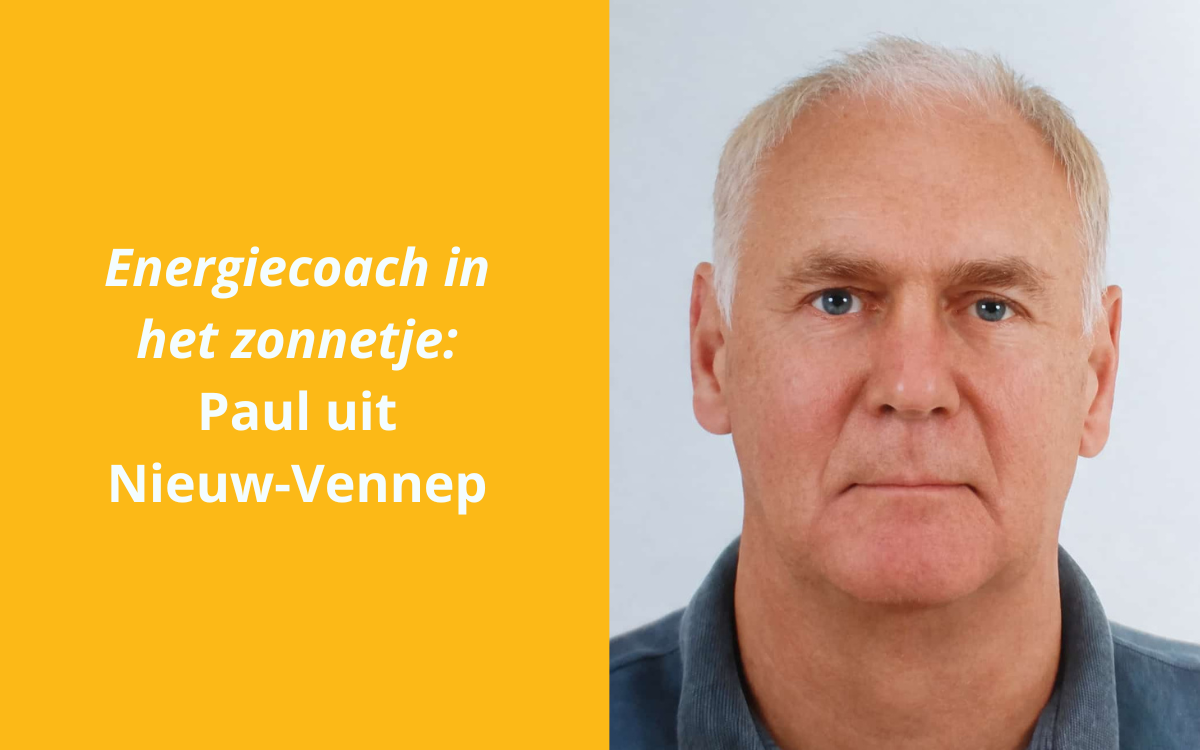
The energy coaches have been working at the Energy Help Desk for some time now, helping local residents make their homes more sustainable. It’s high time we got to know them a little better. Why did they decide to do this work? And what’s their favorite small step to take? The coaches answer these burning questions. Today we’re talking with Paul from Nieuw-Vennep.
Tell us, Paul, why did you become an energy coach?
I retired in 2024. I spent my entire career at KLM, where, as a project manager, I was responsible for the development and construction of buildings and renovations. Sustainability always played an important role in these projects. After I retired, I wanted to remain active in a role where I could apply my technical and project management expertise.
How do you make your own life more sustainable?
Living in a VINEX neighborhood built after 2000 means that the homes are often already fairly energy-efficient. I personally had eleven solar panels installed and purchased a heat pump. I’ve also set my heating temperature to 20 degrees in the evening. And of course, I use LED bulbs, have installed foil behind the radiators, and close the curtains in the evening.
Which measures would you most recommend?
In conversations with residents, I’ve noticed that many people are already familiar with potential sustainability measures. However, due to the abundance of—sometimes conflicting—information in the media and online, they often can’t see the forest for the trees, which ultimately prevents them from taking action.
I regularly come across situations where relatively simple improvements are possible. For example, homes with underfloor heating where the floor isn’t insulated, or where the heat pump doesn’t have a smart switch. I also often see open connections between the ground floor and an uninsulated attic. Installing a partition—preferably with a door—can save a significant amount of energy. In addition, many residents have invested in plastic window frames with high-efficiency glass without realizing that they were (or still are) eligible for a subsidy: in many cases, applications for this can still be submitted up to two years retroactively.
What's the most fun or memorable conversation you've had so far?
Actually, all the conversations are enjoyable. Residents prepare well, which makes the conversations even more interesting. One striking example was a resident from Badhoevedorp. He did everything he could to save energy, but still paid more for electricity than his neighbor. It turned out that his electrical connection was far too large for his actual usage, causing him to overpay about €1,250 annually in base rates.
Thank you, Paul! Would you like to know what Paul and the other energy coaches can do for you, or would you like to schedule a consultation right away? Then go to this page. Would you like to make an immediate impact in your neighborhood, just like Paul? We’re looking for new energy coaches! On this page, you can sign up and find more information about becoming a coach.